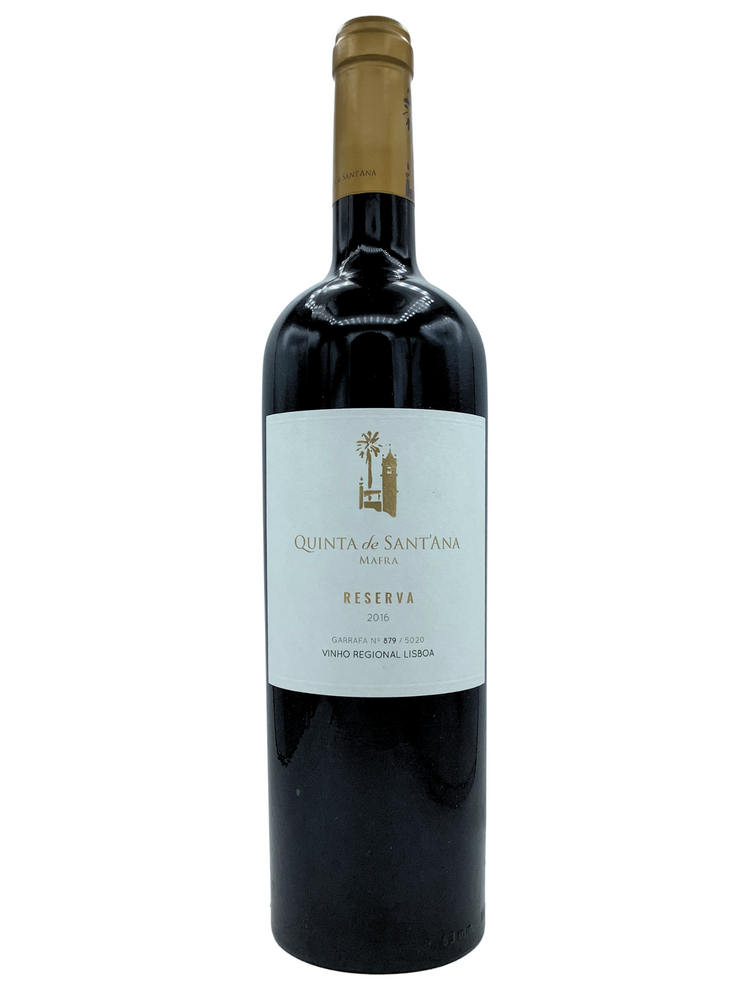

2016 Quinta de Sant'Ana Reserva Tinto
- Regular price
- $24.99
- Regular price
-
$59.99 - Sale price
- $24.99
- Unit price
- per
Type Wine
Red
Read About the WineAvailability varies by store. If you experience an issue at checkout, please try purchasing this item separately. If your order is assigned to a different store at checkout, place it, then contact us and we’ll assist.
Shipping is unavailable in Wisconsin
Get to Know This Product
97 Points — In Vino Veritas
"A monument of a wine from Portugal's Lisboa region, the 2016 Quinta de Sant'Ana Reserva Tinto is everything the Super-Douro concept promises and then some. The nose is extraordinary: crème de cassis, dark plum and blackberry at the core, layered with cedar, graphite, dark chocolate, dried violet and a whisper of eucalyptus and pine resin that is unmistakably Portuguese. Nine years of bottle development have done their quiet, meticulous work — the tannins, once powerful and assertive, have resolved into something silky and completely integrated, while the fruit has deepened from fresh and primary into a complex, tertiary richness that keeps revealing itself across an entire evening. The palate is full-bodied, voluminous and deeply concentrated, yet possessed of a freshness and energy — the Atlantic breezes of Mafra running through the wine's spine — that prevents the power from becoming merely ponderous. The finish is extraordinarily long, dark-spiced and authoritative. For lovers of great Napa Cabernet who have not yet discovered what Portugal's finest blended reds can achieve, this is the bottle that will permanently alter their understanding of what is possible. Drink now through 2030." — In Vino Veritas, 97 Points
In the 1970s, a group of Tuscan producers did something the Italian wine establishment found deeply irritating and the rest of the wine world eventually found irresistible: they blended indigenous Italian grapes with international varieties — Sangiovese with Cabernet Sauvignon, Merlot alongside Cabernet Franc — and produced wines of such extraordinary power, concentration and elegance that the entire classification system was forced to reckon with what they had done. The Super Tuscans were born. Sassicaia. Ornellaia. Tignanello. Wines that changed the conversation about what Italian fine wine could be.
Portugal has its own answer. The 2016 Quinta de Sant'Ana Reserva Tinto is, in the most precise possible sense, a Super-Lisboa.
Call it a marriage of Merlot — the great Pomerol grape, the variety that makes Pétrus the most coveted red wine on earth — with Touriga Nacional, Portugal's most noble indigenous variety, the grape that gives Portuguese red wine its particular combination of floral intensity, dark fruit and structural gravitas. International conviction blended with Portuguese soul. The result is something that speaks fluently to lovers of great Napa Cabernet — the power, the concentration, the dark fruit generosity, the oak-integrated depth — while carrying underneath it all that particular Atlantic-kissed freshness that the Lisboa region's calcareous clay and ocean breezes produce and that warm-climate wines from California simply cannot replicate.
The quinta itself dates to 1633. Let that number settle for a moment before we discuss the wine. Sixteen thirty-three. Quinta de Sant'Ana sat on the rolling hills of Mafra, bordering what was then the Tapada de Mafra — the royal hunting grounds of the Portuguese kings, a vast protected landscape of pine and oak and ancient stone walls where the monarchy came to hunt and the land was kept in something close to its natural state. The Atlantic was 20 kilometers away. The calcareous clay soils were — and remain — some of the most distinctive in the Lisboa wine region, giving the vines both the structure they need and the cool-night freshness that keeps everything alive and precise rather than baked and blowsy.
The 2016 is now 10 years old, and that matters. For a wine this concentrated and structured, a decade in bottle is exactly where things get interesting: the fruit deepens, the tannins settle and the whole wine begins to show the complexity it was made to develop.