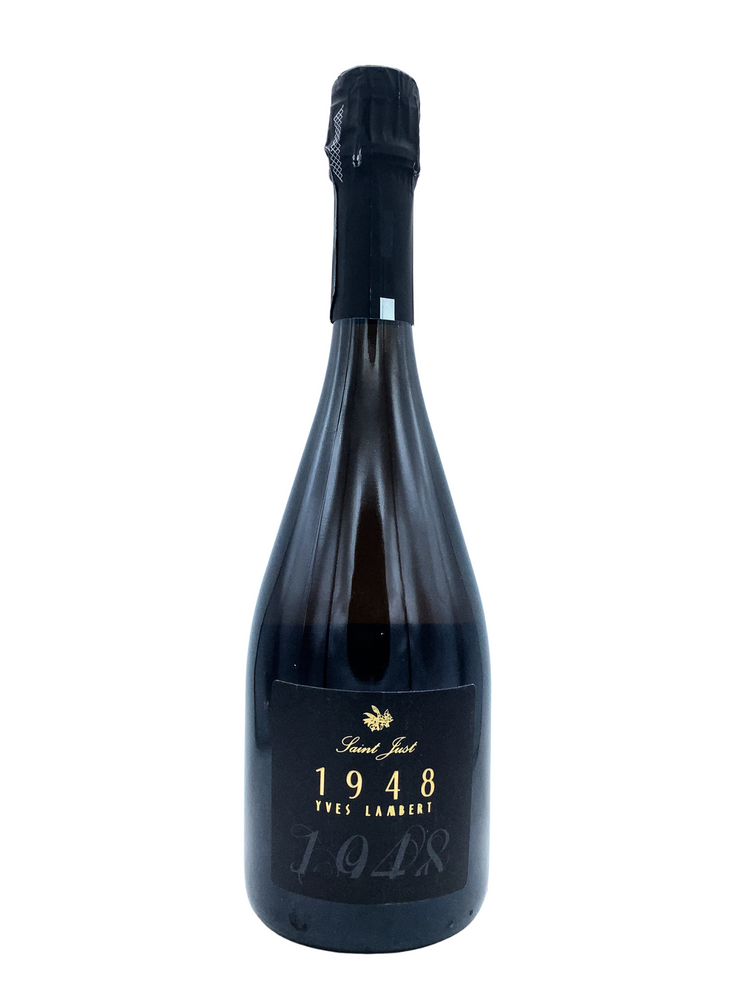

Arnaud Lambert "1948" Crémant de Loire Blanc Brut Nature
- Regular price
- $49.99
- Regular price
-
$69.99 - Sale price
- $49.99
- Unit price
- per
Type Sparkling
White
Read About the WineAvailability varies by store. If you experience an issue at checkout, please try purchasing this item separately. If your order is assigned to a different store at checkout, place it, then contact us and we’ll assist.
Shipping is unavailable in Wisconsin
Get to Know This Product
I am going to admit something right up front: I was not prepared for this wine.
Crémant de Loire occupies a slightly dangerous corner of the wine world. We know it can be good. We know Chenin Blanc can make terrific sparkling wine. We know the limestone country around Saumur is capable of producing wines of almost preposterous mineral intensity. And yet, psychologically, we still tend to put Crémant into the category of pleasant alternative to Champagne.
Then Arnaud Lambert pours you 1948, and that entire hierarchy gets rather inconvenient.
First, the name. 1948 is not some mysterious cuvée number. It is the year these Chenin Blanc vines were planted. The wine comes from old-vine Chenin rooted in a remarkably thin layer of clay — Lambert specifies roughly 30 centimeters — over limestone. These are often described as 70-year-old vines, but the point is more specific and more compelling: this is Chenin Blanc from vines planted in 1948.
And if you know Arnaud Lambert’s wines, this makes perfect sense. Lambert is one of the great modern interpreters of Saumur, a grower devoted to the region’s individual terroirs rather than treating Saumur as one homogeneous landscape. His father, Yves, founded Domaine de Saint-Just in 1996; Arnaud joined him in 2005, and the domaine subsequently converted to organic farming while taking over important vineyards associated with Château de Brézé.
That Brézé/Saumur landscape matters enormously here. Chenin Blanc planted over limestone can possess an almost architectural quality: fruit on top, acidity running through the middle, and underneath everything that wonderfully chalky, saline sensation that makes the wine feel less like something you drink and more like something you are excavating.
And Lambert does not exactly take the easy route with 1948. It is 100% Chenin Blanc, made by the traditional method. The base wine spends roughly six to eight months in used barrels that have already seen three to five wines, followed by 36 months sur lattes, developing on its lees in bottle. Then comes the particularly important bit: zero dosage. Brut Nature. Nothing added to cosmetically soften the edges.
Which explains why this wine absolutely knocked me sideways.
The 2021 is gorgeous — not exuberant or showy, but almost unnervingly precise. The nose begins with preserved lemon, crisp yellow and green orchard fruit, white flowers and chalk dust, with a delicate suggestion of freshly baked brioche emerging as it warms. There is a faint nuttiness lurking behind the fruit as well, something between almond and hazelnut, but the dominant impression remains one of limestone, citrus and coolness.
Then you taste it.
This is where 1948 stops being “very good Crémant” and simply becomes very serious sparkling wine.
Bone dry, incisive and almost lapidary in its precision, it has an extraordinarily fine mousse that seems woven into the wine rather than sitting on top of it. Lemon peel, green apple and quince move through the palate before that old-vine Chenin concentration comes through: not weight exactly, but density without heaviness. There is chalk, crushed oyster shell, a little brioche and an almost mouthwatering saline bitterness through the finish. The zero dosage is not a parlor trick; it reveals the wine’s structure. Nothing obscures the fruit, nothing rounds away the acidity, nothing gets between you and that wonderful limestone-derived sense of place.
And this is perhaps what impressed me most. It is not trying to taste like Champagne.
It has Champagne-level seriousness, certainly. It has the lees aging, the fine mousse, the autolytic complexity and the almost painfully precise balance we associate with excellent grower Champagne. But underneath all of that is unmistakably Chenin Blanc from the Loire: quince instead of Chardonnay’s citrus creaminess, a slightly woolly-floral undertone, tremendous acidity, and that particular combination of chalk, salt and orchard fruit that belongs to this part of France.
That distinction matters. The excitement is not that Arnaud Lambert has figured out how to make inexpensive Champagne somewhere else. It is that he has made something so accomplished the comparison becomes unnecessary.
Which brings me back to those vines planted in 1948.
Old vines alone do not make great wine, of course. But old Chenin, limestone, restrained élevage, three years on the lees and zero dosage create a fairly compelling set of raw materials. Lambert simply has the intelligence — and perhaps the good sense not to interfere too much — to bring those elements into extraordinary focus.
The more I think about this bottle, the more remarkable it seems. It punches hilariously above the expectations of its appellation: concentrated without being rich, austere without being severe, complex without becoming ponderous.
Sometimes the great pleasure of Terroir Club is finding an obscure little corner of the wine world and realizing that someone there is doing work completely disproportionate to the region’s reputation.
1948 is one of those wines.