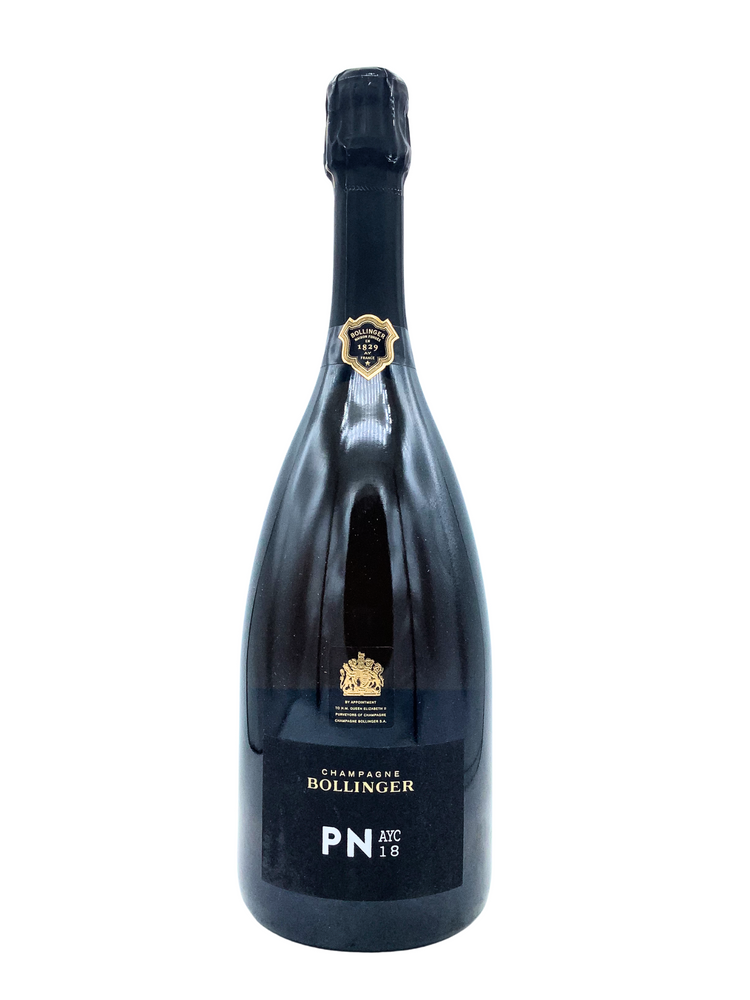

Bollinger PN AYC 18
- Regular price
- $169.99
- Regular price
-
$189.99 - Sale price
- $169.99
- Unit price
- per
Type Sparkling
Read About the WineAvailability varies by store. If you experience an issue at checkout, please try purchasing this item separately. If your order is assigned to a different store at checkout, place it, then contact us and we’ll assist.
Shipping is unavailable in Wisconsin
Get to Know This Product
Bollinger making a Champagne devoted entirely to Pinot Noir feels a little like Porsche deciding to build a car specifically to investigate the possibilities of the flat-six engine. This is not exactly unfamiliar territory.
Pinot Noir is the marrow of Bollinger. It is the grape around which the house has built its identity: richness without heaviness, power disciplined by acidity, and the deeply vinous character that makes great Bollinger one of Champagne’s most substantial and gastronomic expressions. So when Bollinger created its PN series, the idea wasn't to invent something new so much as to take its own DNA apart, put it under a microscope, and see exactly what makes the machine go.
And PN AYC18 may be one of the most fascinating iterations yet.
First, the slightly cryptographic name deserves decoding. PN is Pinot Noir. AYC refers to Aÿ-Champagne, the historic Grand Cru village at the heart of this edition. And 18 identifies 2018 as the base harvest. Bollinger itself formally calls the wine Champagne Bollinger PN AYC18; stylistically, the useful expanded description is Bollinger PN AYC18 Brut Blanc de Noirs, because this is 100% Pinot Noir, vinified as white Champagne. It is the fourth release in Bollinger's PN series, with each edition centered on a particular Pinot Noir terroir and base year.
This is where things get wonderfully geeky.
Aÿ is not simply another source of Pinot Noir for Bollinger. It is the spiritual center of the house. Bollinger is based there, owns important vineyards there, and has spent generations developing a style intimately connected to the village's unusually powerful expression of Pinot Noir. Aÿ sits where the Montagne de Reims begins to fold toward the Marne, with superbly exposed vineyards rooted in Champagne's deep chalk. Pinot here can possess an almost paradoxical combination of muscle and precision: broad through the middle, yet chalky and tensile underneath.
That is exactly what Bollinger wanted PN AYC18 to investigate.
The wine is 100% Pinot Noir, predominantly from Aÿ, supplemented by Pinot from other villages including Tauxières and Verzenay. The base vintage is 2018, a warm, early and abundant Champagne harvest in which the region's chalk soils proved particularly valuable, moderating the growing conditions and helping preserve acidity even as the fruit achieved considerable concentration.
But calling this a "2018 Champagne" would badly undersell what is going on inside the bottle.
Only about 53% of the assemblage comes from 2018. The remaining 47% is reserve wine, including older material stretching all the way back to 2009. And this is Bollinger, so some of those reserves come from the house's extraordinary collection of wines aged in magnums under cork — an expensive, laborious, almost magnificently anachronistic practice that allows reserve wines to develop slowly while retaining freshness. In PN AYC18, those mature reserves aren't merely seasoning; they constitute nearly half the architecture of the wine.
This is why the Champagne manages the wonderful trick of tasting simultaneously young and mature.
The 2018 fruit supplies generosity, flesh and immediacy. The reserve wines bring something more autumnal and cerebral: nuttiness, dried fruit, spice, toast and the beginning of those savory tertiary flavors that normally require patience in your own cellar. More than half of the wine was vinified in oak, another very Bollinger-ish piece of the puzzle, and the finished Champagne spent roughly four years aging on its lees before its January 2023 disgorgement. Dosage is a restrained 6 grams per liter.
Put all of that together and you get Champagne with a rather unusual amount of gravitas.
The nose begins broad and golden: quince, baked yellow apple, blood orange, preserved lemon and honeycomb, then almond paste, brioche crust and toasted hazelnut. Give it some air and the profile shifts. Candied citrus becomes fresher and more bitter-edged; sweet spice begins to emerge; there's a faint cooling herbal quality somewhere between mint and dried alpine herbs. Beneath all that generosity is chalk — quiet at first, then increasingly insistent.
The palate is where Aÿ becomes unmistakable. This isn't a wispy Blanc de Blancs defined by citrus and electricity. It has shoulders. Pinot Noir gives it a broad, almost Burgundian mid-palate, with orchard fruit, orange oil, quince paste and pastry wrapped around a remarkably fine mousse. Yet the wine never becomes ponderous. The chalk underneath it acts almost like a skeletal structure, pulling all that fruit and reserve-wine richness taut.
And that tension is the whole point.
Bollinger describes Aÿ Pinot Noir in terms of straightness, length and amplitude, which sounds suspiciously like marketing until you taste this wine and realize that those three words are actually pretty darn good. It expands across the palate and then, instead of becoming soft, contracts into something increasingly saline, chalky and citrus-driven. The finish is long, savory and faintly bitter with candied orange peel, almond, chalk dust and spice.
There is something delightfully Bollingerian about the entire exercise. Plenty of Champagne houses could make a 100% Pinot Noir Blanc de Noirs. Bollinger makes one by blending a warm, generous base year with almost half reserve wine, reaching back nearly a decade, incorporating its famously obsessive magnum reserve system, leaning into oak fermentation, and then giving the whole thing extended cellar aging.
Of course they do.
But PN AYC18 isn't merely Bollinger turned up to eleven. What makes it compelling is that all that technique ultimately points back toward somewhere very specific: Aÿ. This is Champagne as a study of place rather than simply house style, and that makes the PN project intellectually fascinating as well as delicious. Each edition considers essentially the same question — what can Pinot Noir become in the hands of Bollinger when one particular terroir shapes the result?
Here the answer is rich, vinous, chalky, savory and wonderfully expansive.
And perhaps that is why I love wines like this for Terroir Club. Champagne can too easily become a language of brands and prestige cuvées. PN AYC18 takes us in the opposite direction: one grape, one dominant village, one base harvest, interpreted through generations of accumulated cellar knowledge. It gives us something to drink, certainly, but also something to investigate.
Pour this one into a proper wine glass rather than a flute, and don't serve it glacially cold. Bollinger recommends roughly 50–52°F, and they're right. Let it warm and unfold. Give it food — roast chicken, Comté, mushrooms, scallops browned in butter, even veal or pork — and watch how quickly the distinction between "Champagne" and "serious wine" becomes rather academic.
I don't usually put numbers in these letters, but I'll make an exception this once, because it felt like the honest thing to do. This bottle sells on its own, quietly, for $189.99. The Champagne Club is $125 a month. Which means this single bottle, sitting in this month's box, is already worth more than what got you in the door — before we've touched anything else waiting alongside it. I'm not telling you that to boast about a deal. I'm telling you because this felt like the kind of month that deserved to feel generous, and I wanted you to know exactly what you're holding.
Because beneath the bubbles, that's precisely what PN AYC18 is: Aÿ Pinot Noir, seen through the wonderfully obsessive lens of Bollinger.