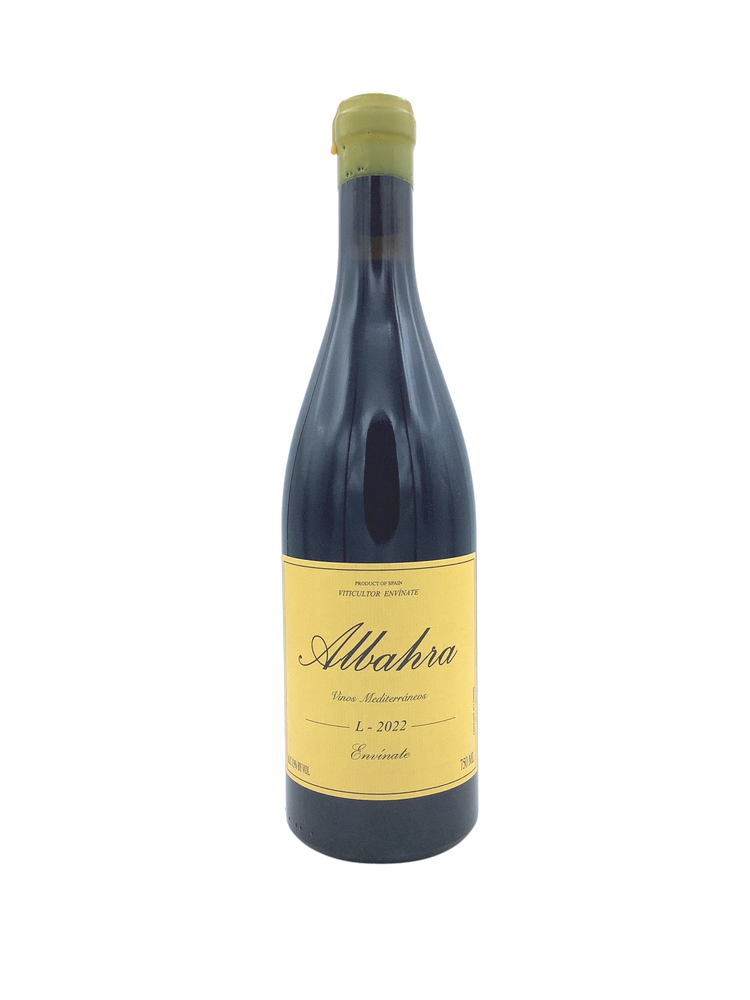

Envinate Albahra (Yellow Label NOT Chingao) 2025
- Regular price
- $37.99
- Regular price
-
- Sale price
- $37.99
- Unit price
- per
Type Alicante Bouschet
Read About the WineAvailability varies by store. If you experience an issue at checkout, please try purchasing this item separately. If your order is assigned to a different store at checkout, place it, then contact us and we’ll assist.
Shipping is unavailable in Wisconsin
Get to Know This Product
There's a grape called Garnacha Tintorera — also known as Alicante Bouschet, its better-known French name — and almost no one has ever accused it of being distinguished on its own. It's a teinturier variety, one of the rare grapes with red flesh beneath the skin. For most of its history, that was its principal selling point: a workhorse grown to add color and weight to thinner wines. Nobody made a name with it. Nobody was supposed to.
Then four friends who met studying oenology at the University of Alicante decided otherwise.
Envínate — the name is a little joke, roughly "wine yourself" — is Laura Ramos, Jose Martínez, Roberto Santana and Alfonso Torrente. Rather than settle into one winery after graduation, they spread out across some of Spain's most extreme terroirs: Roberto in the volcanic vineyards of Tenerife, Alfonso in the river gorges of Ribeira Sacra in Galicia, and Laura and Jose here in Almansa, in the dry southeastern corner of Castilla-La Mancha, working with a grape few others took seriously.
So what are Laura and Jose doing with a glorified blending grape? Showing just how much it's capable of.
Albahra comes from organically farmed vines at 800 meters — genuinely high altitude for this part of Spain — on chalk and clay soils. Even through brutal Mediterranean summers, the vineyard experiences significant temperature swings between day and night. That altitude helps keep a grape known for its deep color and heft remarkably bright, lifted and alive.
In the cellar, they get out of its way almost entirely: wild yeast fermentation in open-top concrete tanks, roughly a third of the fruit left as whole clusters, then eight months of aging in concrete rather than oak. No barrels softening the edges, no new wood adding flavors that aren't already there. Just the grape, the altitude and time.
The result is dark, juicy red fruit with a fresh, almost carbonic lift to the aromatics, floral and herbal notes underneath, dusty tannins and enough acidity to hold it all together. It drinks lighter and more energetically than its reputation would suggest — closer to a cool-climate red you'd reach for in summer than the heavy blending wine of its past.
Pour it slightly cool alongside something with real flavor: charcuterie, grilled meats, a good pisto manchego, grilled eggplant or even a heartier seafood dish. This is exactly the kind of wine Terroir Club exists to put in front of you: an overlooked grape in the hands of winemakers talented enough to prove its reputation wrong.
— Ben