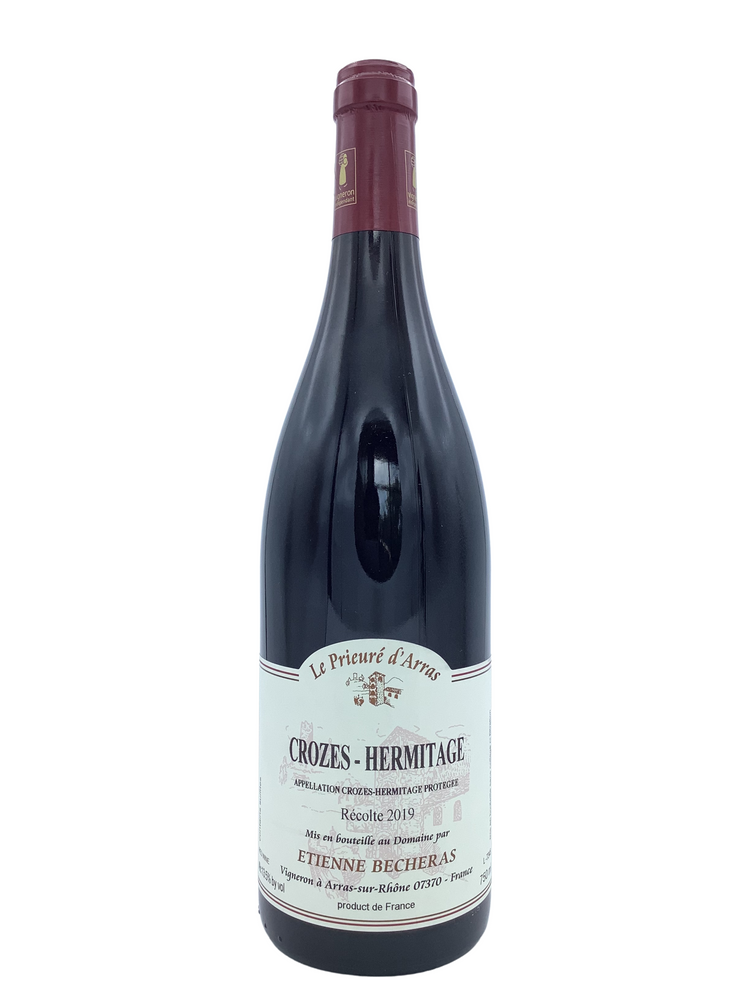

Becheras Crozes Hermitage le Prieure d'Arras 2023
- Regular price
- $36.99
- Regular price
-
- Sale price
- $36.99
- Unit price
- per
Type Syrah
Read About the WineAvailability varies by store. If you experience an issue at checkout, please try purchasing this item separately. If your order is assigned to a different store at checkout, place it, then contact us and we’ll assist.
Shipping is unavailable in Wisconsin
Get to Know This Product
Most people who make serious wine only grow grapes for wine. Etienne Bécheras grows grapes, cherries, apricots and truffles on the same twelve hectares, in the same small commune of Arras, on the west bank of the Rhône. Only four of those hectares are actually vines. The rest is orchard on the flat riverside ground and forest kept for timber and truffle. This is not a wine estate that happens to have some fruit trees on it. It's a working farm that also happens to make one of the more serious bottlings coming out of Saint-Joseph right now.
The vines get the hard ground, because that's where they belong. Steep hillside, limestone and gravel, terraced by hand generations ago because there was no other way to farm a slope like that, worked almost entirely by hand today because there still isn't. The vines range from ten to sixty-five years old, farmed organically, and the whole four-hectare parcel produces a total of about 8,000 bottles a year across everything Bécheras makes. This particular cuvée, labeled Le Prieuré d'Arras, comes off two of the rockiest hillside parcels on the property — the ones nobody would plant if they had an easier option.
So what's actually in the glass? This is 100% Syrah, cold-macerated for about three days, then fermented three to four weeks on native yeast, and aged eighteen to twenty-four months across a mix of barrel sizes — 225, 400 and 600 liters — longer élevage than most of Saint-Joseph bothers with. No fining, no filtration. Bécheras has a reputation as someone willing to take the slower, riskier route when he thinks the wine will be better for it, and this bottling is the clearest argument for that reputation.
The result is dark, plummy fruit shot through with pink peppercorn and dried wild herbs, with that pencil-lead minerality that good Northern Rhône Syrah gets from ground like this. The tannins are young and emphatic right now — this wants a decant, or a few more years in your own cellar — but it's rich without tipping into heavy, and structured without ever getting aggressive about it.
If your mental map of Northern Rhône Syrah runs through Côte-Rôtie and Hermitage, Saint-Joseph is where growers who don't have that address, or don't particularly want it, go to prove the grape doesn't need it. It has a reputation for smoky, leathery, earthy reds with real muscle, and Bécheras's version leans into all of that while staying more precise than brawny — a wine made by somebody paying just as much attention to two rocky hillside parcels as he pays to his cherry trees.
Give it a decant, pour it with something that can stand up to it — lamb shank over polenta, braised poultry, a good long-simmered ragoût — and let those tannins soften into the meal rather than fighting you for attention.